After the income tax, the other main form of tax is the consumption tax: a tax on items actually purchased. The most common form of this tax in the U.S. is the sales tax; in the European Union (EU) and many other countries it is the Value Added Tax (VAT). The main difference between them is the way the taxes are collected.
In a sales tax, the tax on a particular item (or service) is calculated and assessed only on the end-user. The manufacturer, wholesaler and retailer pay nothing, only the final consumer or purchaser pays. Of course, the "middlemen" – manufacturer, wholesaler, retailer e.g.—must have government documents to show that they are not end-users. (The middlemen may have to pay income taxes on their profits, of course.) The retailer must then collect the sales tax from the customer and send it to the government.
In the case of a VAT, each middleman pays the previous middleman for an item, then does something to increase the value of the item (hence the name "Value Added Tax"), then sells the item at the increased price, which includes tax, to the next in line. Each middleman then pays the government the tax charged for the “improved” item less the tax paid by the previous middleman. Thus, each middleman ends up paying the government only the tax on the value that his/her contribution added to the item. Since the final consumer has now paid the full price on the total value of the item (to the last intermediary), and resells to no one, the consumer owes the government nothing. In effect, the government is collecting the same total in taxes as with the sales tax, but is paid by the intermediaries -- who are paid stepwise by each other and, finally, by the end-user or consumer.
For more details and numerical examples of how this works, see the Wikipedia article on VATs.
Since only the consumer under a sales tax pays the government, the intermediates have no stake in whether the next person pays tax or not. With a VAT, however, everyone pays tax (unless they illegally falsify their records) and so the intermediates need to keep track of input and output in order to justify paying the government just the difference in taxes (they have already payed the intermediate preceding them).
Thus, VATs and sales taxes are really not that different in terms of money collected, but the VAT may be an improvement in the integrity or honesty of collection -- although it has been argued that its complexity may make up for that. The VAT is certainly more effective in collecting taxes on Internet sales since these taxes are all collected before the item is sold on the Web.
Both sales taxes and VATS vary a lot from country to country, and from state to state in the U.S. (and some cities also). The EU has certain ground rules for its member nations, though a considerable amount of flexibility is still permitted. There are no national rules in the U.S. on states' taxes, but most are deductible, at the present, from federal taxes.
The problem with consumption taxes is that they tend to be regressive; that is, their burden falls heaviest on lower income people, and lightest on the very rich. The reason, as is so often the case, relates to disposable income. Everyone must eat, drink, obtain shelter and medical care, and be able to get around; to do this, people usually have to make purchases: food, clothing, medicines, houses and cars, for example. For lower income families, these necessities require a large percentage of income -- sometimes all; taxing them creates quite a burden on a family's financial resources. Wealthy people, on the other hand, have a lot of income above what they need to live, even if they have expensive tastes. This income is only subject to a consumption tax when and if it is spent: it is discretionary or disposable. Thus, the consumption tax burden on these affluent families tends to be much lighter than on poorer ones.
A lot of the variation in consumption taxes results from the desire to mitigate this regressive nature. Certain basics such as food, shelter and medicines may be taxed at lower rates or not at all. For example, the EU excludes charities, health and education from the VAT, while Massachusetts doesn't tax food, clothing and medical care in its sales tax.
The regressive nature of consumption taxes may also be partially neutralized by fixed lump-sum payments to all taxpayers, or by combining VATs, say, with a highly progressive income tax (i.e. one that has much higher tax rates for those with high incomes).
An interesting example is Denmark, which has a very high but fairly progressive income tax, combined with the highest VAT in Europe: 25%. The result is the highest combined tax rate in the world, a good part of which is the regressive VAT, to which there are hardly any exceptions. Yet, Denmark also has one of the most financially egalitarian economies in the world. This is because the high taxes are used in a very progressive way: on social spending, retirement security, and medical coverage. It is exactly that segment of Danish society which is hit so hard by the regressive VAT that benefits most from this spending. The Danes believe, and with good reason, that their government is part of the solution and not the problem. Of course, it is their government and they have created it to be progressive and humanitarian: they don't fight very many wars, and have been at the forefront of development of agricultural products and wind power.
How then should we react to suggestions that the U.S. introduce some sort of VAT? At this point in our history, when the "cut-the-deficit-by-any-means" forces are rampant, I think it would be very dangerous to create anything so inherently dangerous to economic democracy as a federal consumption tax. The political armies of the reactionary right, consisting of the know-nothing Tea Screamers and the Chamber of Commerce and Club For Growth, as well as the beneath-contempt Republicans, seem more likely to do true mischief to most poor and middle-class Americans than can be countered by the confused and divided Democrats. Sufficient unto the day is the unfair tax policy thereof.
In any case, here's a litmus test for any consumption or VAT tax that may be proposed. Does it contain a Financial Services or Securities Transfer tax (see my blog on the Parasite Tax) on the purchase and sale of stocks and bonds? If it doesn't, you can be sure that it is a stalking horse for yet more regressive taxes that favor the rich.
Thursday, April 28, 2011

Tuesday, April 26, 2011
Winning Progressive on Krugman's column
The following is from Winning Progressive, and is a response -- in support of -- a column by Paul Krugman which appeared in the New York Times on April 24.
My comment on Paul Krugman’s NYT column Let’s Take a Hike, which focuses on the need for tax increases, such as those proposed in the House Progressive Caucus budget, as a core element of any deficit reduction plan:
First, in response to your question about why, if the deficit is purportedly such a serious problem, are Republicans proposing further tax cuts, the reason is that the Republicans are not serious about reducing deficits. They intentionally created deficits in order to make their efforts to eliminate Social Security, Medicare, and other core government programs that help average Americans politically palatable. They haven’t succeeded in that goal and, therefore, Republicans hope to continue pushing the deficit up until they do succeed.
Second, thank for highlighting the House Progressive Caucus budget proposal. As you note, by asking the wealthy elite to begin paying their fair share again and cutting defense spending and corporate subsidies, The People’s Budget reaches fiscal balance in 10 years, which is far quicker than either Rep. Ryan’s Path to Poverty plan or President Obama’s proposal. In the parlance than the chattering classes like to use, it is the House Progressive Caucus proposal that is serious, as it uses real numbers and policies to achieve actual fiscal balance without further undermining our middle class or preying on the least fortunate among us.
Third, in addition to the insincerity of the so-called “deficit hawks” (who are really deficit vultures for the reasons identified in my first paragraph above), the other reason that the House Progressive Caucus budget has not received much attention is because it goes against the conventional wisdom peddled by the chattering classes. That “wisdom” holds that cuts to Medicare and Social Security are necessary, that taxes cannot be raised, that defense spending cannot be touched, and that programs for the middle class, working class, and the least fortunate among us must be slashed. And the reason those points constitute “wisdom” in DC is that the chattering classes are in economic circumstances that foreclose them from personally experiencing the critical importance of programs like Social Security and Medicare and cause them to worry more about being asked to pay their fair share, and because most of our media enjoys the war porn that creates ratings for their networks.
A final point is that these contrasting visions of our nation’s fiscal future are really about what sort of Country We Believe In, as our President explained in his recent speech on fiscal policy. Do we want a nation that continues to lavish spending on the military and let’s the richest few percent continue to amass boatloads of wealth while our infrastructure and education system crumbles, security for our senior citizens disappears, and the social safety net is shredded? Or, do we believe in an America where we can once again have a stable middle class, where people who worked all their lives can have a secure retirement, where our children receive world class education, where our infrastructure system is again the best in the world, and where all are asked to pay their fair share for the cost of civilization? If you share my belief in the latter vision of America, now is the time to get involved in making it happen.
Monday, April 25, 2011
More seriously: Social Security taxes
I have mentioned several times that part of any attempt to fix our fiscal problems should be raising the income level for which Social Security taxes are imposed. Right now that level is $106,800: that part of one's income (from wages) below that level is taxed at 6.2%, while the rest above that is tax-free (there is also a matching employer contribution).
This cutoff was created to "save Social Security" through the efforts of a bipartisan panel during the Reagan years. In those days, even under the conservative Ronald Reagan, it was possible to deal rationally with Republicans. Some of the history and reasons (e.g. income inequality) why that cutoff level is no longer sufficient is presented in this week's GoozNews: it's worth reading.
This cutoff was created to "save Social Security" through the efforts of a bipartisan panel during the Reagan years. In those days, even under the conservative Ronald Reagan, it was possible to deal rationally with Republicans. Some of the history and reasons (e.g. income inequality) why that cutoff level is no longer sufficient is presented in this week's GoozNews: it's worth reading.
Good comic
Sarah sent me the URL for this comic. Partly because I liked it and partly because I'm experimenting with ways to display items in this blog, here it it is.

Saturday, April 23, 2011
Taking his word?
The "birther" position is as beneath contempt as most any other Republican position these days, and I won't comment on it. However, several Republicans, after being shown the birth certificate that Hawaii issued for the President, said that now they "take his word for it." Though this would probably be lost on them, there is a matter of principle here. To wit:
No, they aren't and shouldn't be taking "his word for it." They are and should be taking the official word of the state of Hawaii. The document is the only birth certificate Hawaii issues upon request. It is the official document; it is the legal last word. When these Republicans claim to show their own birth certificates, they are showing a document no more and no less compelling than this document.
Taking "his word for it" is condescending BS and indicates that they still cling to some hope that they can extract political advantage from the "birthers". What part of "beneath contempt" don't I understand? I better sign off here.
Friday, April 22, 2011
Inheritance taxes
Concerning the issue of fairness, discussed in the last blog, there is the matter of inherited wealth and the control of our country and its economy. Not only does the top 1% of income earners collect 24% of income, as remarked above, but it also controls about 42% of all wealth (stocks, bonds, businesses, property etc.). Here’s a chart from MyBudget360:
 If this wealth is passed down via inheritance, the result is a few very wealthy families with not only immense economic power from their huge financial holdings, but with the vast political power that such wealth can purchase through lobbying and political donations.
The Founding Fathers (Madison, Jefferson, Adams etc.) saw these effects of concentrated inherited wealth in Europe and were fearful of them. In a letter to Madison, Jefferson wrote: “Another means of silently lessening the inequality of property is to exempt all from taxation below a certain point, and to tax the higher portions of property in geometrical progression as they rise.”
The distaste for vast inherited wealth was, throughout American history, not confined to any political party.
Teddy Roosevelt said that federal taxes should “put a constantly increasing burden on the inheritance of those swollen fortunes, which it is certainly of no benefit to the country to perpetuate.”
Herbert Hoover, a conservative Republican, described the inheritance tax as "one of the most economically and socially desirable—or even necessary of all taxes" to curtail the "evils of inherited economic power."
There is an unbroken line of belief, from colonial times to the present, in progressive income taxes and inheritance taxes. They are as American as apple pie.
Wednesday, April 20, 2011
Tax cuts and tax fairness
Nothing has been more persistent than the claim that tax cuts either "pay for themselves" or, in fact, increase growth. It seems hardly possible to dispel this notion, in spite of the fact that all evidence indicates that it is a myth. In response to a comment by an anonymous reader, I discussed this briefly in a previous blog; however, it seems that I still need to say a few more words and give some statistical references.
First of all, whether there are tax cuts or tax increases, the history of capitalism in this country has always been one of recurring "business cycles." These comprise a period of growth (G) then a period of leveling off of growth (L) culminating in a peak (P); these are followed by recessionary periods of varied seriousness (R), then a leveling of decline (L), then a repetition. Schematically, then, we have the cycle:
In the crucible of real-world testing of economic theories -- the only meaningful test, after all -- the conservative program has failed. As the handwriting on the wall says from Daniel 5: "Mene mene tekel upharsin" ("You have been judged in the balance and found wanting").
The data backing up these remarks comes from official statistics reproduced by the Center on Budget and Policy Priorities in this report. Please check it out: it has references to many other sources.
Now we come to "fairness" -- truly a thorny issues. Conservatives like to point out that after the Reagan and Bush tax cuts, the percentage of income tax collected from the top 1% (99th percentile) of tax payers went up, while the share from the lower income percentiles went down. This is supposed to show the liberals that cutting taxes for the rich is some sort of Robin Hood scheme. This is baloney for several reasons. First of all, the actual marginal (highest rate of taxation, or the tax on the last dollar of income) tax rates on the richest 1% are at an all-time low, so that the burden that they pay as individuals is lower than ever. So why are they paying more? One reason is that their income, in comparison with the incomes of the lower brackets, has soared in the last few years (since the '50s and '60s). The wealthiest 1% now make about 24% of all income; furthermore, their income is the highest multiple of the lowest percentile income since 1928: just before the Great Depression.
Here's how Nicholas Kristof of the NY Times puts it:
"The richest 1 percent of Americans now take home almost 24 percent of income, up from almost 9 percent in 1976. As Timothy Noah of Slate noted in an excellent series on inequality, the United States now arguably has a more unequal distribution of wealth than traditional banana republics like Nicaragua, Venezuela and Guyana.
So, they pay a larger percentage of taxes because, in comparison, they are many many times wealthier. Even the top 5% have seen their real income more than double since the 1960s, while the real (adjusted for inflation) income for the lower brackets has remained amazingly constant since 1965. Another reason their tax contribution has gone up is not so much that their marginal rate has gone down but that the kinds of deductions which they can take have been tightened. These include certain business (no more "three-martini lunches e.g.) and certain limitations on mortgage and home equity interest deductions. Similar changes in the standard and child-care deductions have helped the people in the lower income brackets. Conservatives claim that lower tax rates have made the wealthy less likely to hire expensive tax preparers to find loopholes in the tax rules -- I don't buy this and I haven't seen anything but anecdotal evidence to support it.
Mother Jones magazine has compiled more statistics about taxes and incomes of the rich; you can find the article here.
Now, of course, there are those who question why the wealthy should, in fact, pay higher (marginal) tax rates at all. Why, they ask, shouldn't everyone pay, say, 15% of their income? In other words, what justification is there for a graduated income tax? And here we come to the issue of fairness and the concept not so much of taxes as tax burden. To see what's at issue here, let's look at a hypothetical case. I got the following table from MainSt, a non-partisan middle-class financial magazine.
First of all, whether there are tax cuts or tax increases, the history of capitalism in this country has always been one of recurring "business cycles." These comprise a period of growth (G) then a period of leveling off of growth (L) culminating in a peak (P); these are followed by recessionary periods of varied seriousness (R), then a leveling of decline (L), then a repetition. Schematically, then, we have the cycle:
GLPRL, GLPRL, ... etc.
revenues, tax cuts, far from "paying for themselves, seem to be very damaging. And here's the kicker: None of these comparisons take into account the disastrous economic consequences of the Republican/conservative policy on de-regulation of speculation in the financial markets: the Great Recession of 2008-2011 (and still counting).The length of such a cycle can vary, with an average of maybe 5-7 years, though very serious recessions -- including the Great Depression, can themselves last many years. Since the Great Depression and the ascendancy of Keynesian theory, the seriousness has been greatly mitigated -- at least until the recent Great Recession which began around 2008.
The general path of the economy in the U.S. has been upward: most business cycles end in a recovery with the economy in a better state than it had been in the previous cycle, measured in terms of investment and GDP growth. On average this increment from peak-of-cycle P to peak-of-cycle P has been around 2%. There is also the matter of average (over the cycle) real tax revenue per capita; this is a measure of how much the government is actually taking in per person, adjusting for inflation.
Note the phrase "on average." Results do vary from cycle to cycle, which enables us to make comparisons between business cycles and tax policies. In the early '80s, under President Reagan there were a series of "supply-side" cuts in the tax rates, where "supply side" means favoring the investing class. Again, in the early years of the 21st century, the Bush Tax Cuts cut the rates for investors and the wealthy (both supply-side + "trickle down" theories at work). In between, in the '90s there were tax increases on the wealthy under President Clinton. How did these varying tax policies, based on competing economic theories, effect the business cycles?
The answers are quite clear. Comparing the Reagan and Clinton cycles, the recoveries from the recessionary periods of the respective business cycles were quite similar; (about 2%); however, the per capita tax revenues under the Clinton recovery were about twice the size as those under the supply-side Reagan recovery. Thus, the supply-side theory fared no better in terms of recovery, but was a real drag on government revenues. This is part of the reason that, rhetoric aside, the Reagan "conservative" theory resulted in deficits, while the Clinton administration actually achieved the budget balance that the Reaganites merely talked about.
Moving on to the next business cycles, the comparison between the Clinton and Bush years is even more noticeable. The improvement in the economy (investment and GDP growth), from P to P, from Clinton to Bush, was somewhat lower than the historic improvement, but the tax revenue increase was no more than 1/2 % -- virtually nil in comparison with the average over the last 50 years of about 10% (11% under Clinton).
Thus, in terms of economic recovery, there is no discernible difference between Republican/conservative and Democratic/liberal tax policies. But, in terms of real per capita tax
In the crucible of real-world testing of economic theories -- the only meaningful test, after all -- the conservative program has failed. As the handwriting on the wall says from Daniel 5: "Mene mene tekel upharsin" ("You have been judged in the balance and found wanting").
The data backing up these remarks comes from official statistics reproduced by the Center on Budget and Policy Priorities in this report. Please check it out: it has references to many other sources.
Now we come to "fairness" -- truly a thorny issues. Conservatives like to point out that after the Reagan and Bush tax cuts, the percentage of income tax collected from the top 1% (99th percentile) of tax payers went up, while the share from the lower income percentiles went down. This is supposed to show the liberals that cutting taxes for the rich is some sort of Robin Hood scheme. This is baloney for several reasons. First of all, the actual marginal (highest rate of taxation, or the tax on the last dollar of income) tax rates on the richest 1% are at an all-time low, so that the burden that they pay as individuals is lower than ever. So why are they paying more? One reason is that their income, in comparison with the incomes of the lower brackets, has soared in the last few years (since the '50s and '60s). The wealthiest 1% now make about 24% of all income; furthermore, their income is the highest multiple of the lowest percentile income since 1928: just before the Great Depression.
Here's how Nicholas Kristof of the NY Times puts it:
"The richest 1 percent of Americans now take home almost 24 percent of income, up from almost 9 percent in 1976. As Timothy Noah of Slate noted in an excellent series on inequality, the United States now arguably has a more unequal distribution of wealth than traditional banana republics like Nicaragua, Venezuela and Guyana.
C.E.O.’s of the largest American companies earned an average of 42 times as much as the average worker in 1980, but 531 times as much in 2001. Perhaps the most astounding statistic is this: From 1980 to 2005, more than four-fifths of the total increase in American incomes went to the richest 1 percent."
So, they pay a larger percentage of taxes because, in comparison, they are many many times wealthier. Even the top 5% have seen their real income more than double since the 1960s, while the real (adjusted for inflation) income for the lower brackets has remained amazingly constant since 1965. Another reason their tax contribution has gone up is not so much that their marginal rate has gone down but that the kinds of deductions which they can take have been tightened. These include certain business (no more "three-martini lunches e.g.) and certain limitations on mortgage and home equity interest deductions. Similar changes in the standard and child-care deductions have helped the people in the lower income brackets. Conservatives claim that lower tax rates have made the wealthy less likely to hire expensive tax preparers to find loopholes in the tax rules -- I don't buy this and I haven't seen anything but anecdotal evidence to support it.
Mother Jones magazine has compiled more statistics about taxes and incomes of the rich; you can find the article here.
Now, of course, there are those who question why the wealthy should, in fact, pay higher (marginal) tax rates at all. Why, they ask, shouldn't everyone pay, say, 15% of their income? In other words, what justification is there for a graduated income tax? And here we come to the issue of fairness and the concept not so much of taxes as tax burden. To see what's at issue here, let's look at a hypothetical case. I got the following table from MainSt, a non-partisan middle-class financial magazine.
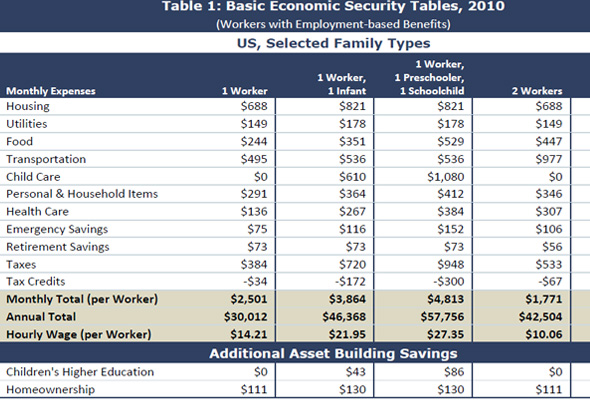
Column 4 represents the finances of a typical family of four with one wage earner. In order to afford the very basics of middle-class life, the hourly salary of the breadwinner must be $27.35 an hour -- with no savings for college and no homeownership. Note that there are absolutely no frills or leeway in this family's finances. One might say that this family has no disposable income. Thus, there is no money for vacations, gifts, parties or dining out. This family is slightly above the median for Americans.
Now imagine a similar family with a yearly income of $135,000, paying even triple the taxes of the first family. This family would have an additional $6,000 per month of income to spend at their discretion: to pay for a house, fancy vacations, tuition at a good college etc. This extra money also buys them less financial stress (which puts a great strain on marriages) and opportunities for personal enrichment such as plays, concerts, music lessons and sports. This family is somewhere in the top 5-10% of American families: not rich by any means, but firmly secure.
It is clear that the tax burden of the second family is far lower than that of the first. In the interest of fairness, we believe that every hard-working family deserves a measure of financial security, educational opportunity, and even a little left over (disposable income) for recreation and relaxation. Thus, to allow this, generations of Americans have agreed that the tax burden be shifted to those families with more disposable income.
To do this, we have a graduated income tax, with gradually increasing rates of taxation for the various segments of a taxpayer's salary, starting from the lowest. Thus, one might pay nothing for the first $20,000, 10% on the next 20,000, etc, up to the highest segment which is taxed at the "marginal" rate. At one time there were literally dozens of segments, and the tax forms had very simple charts where you looked up your taxable income; the chart said something like: "Pay $3700" plus [some percentage] of your income over [a certain number of dollars]." Even before calculators, you just needed one multiplication and one addition to find what you owed.
Another possibility is to have a fixed tax rate for all "earned income" (as we do in Massachusetts), but with a large initial exemption (amount subtracted before calculating taxes) to account for fixed expenses (non-disposable income) -- the theory being that the government should notextract tax money on what you need simply to live. This kind of tax system is not as fair as the graduated one, but it is hard to get people to see this because most people don't want to do the math to make the comparison. When Massachusetts had a referendum on the graduated income tax, large businesses and wealthy people launched a campaign that eventually convinced a large majority of the people who would have benefited from this reform to vote against it. (Opponents said that the calculations would be too complicated to understand, and that, by some infernal, magical gimmick, "the government" would somehow extract more money from you: the usual Big Lie propaganda technique.)
Anyway, thanks for you patience if you've read this far.
Subscribe to:
Posts (Atom)